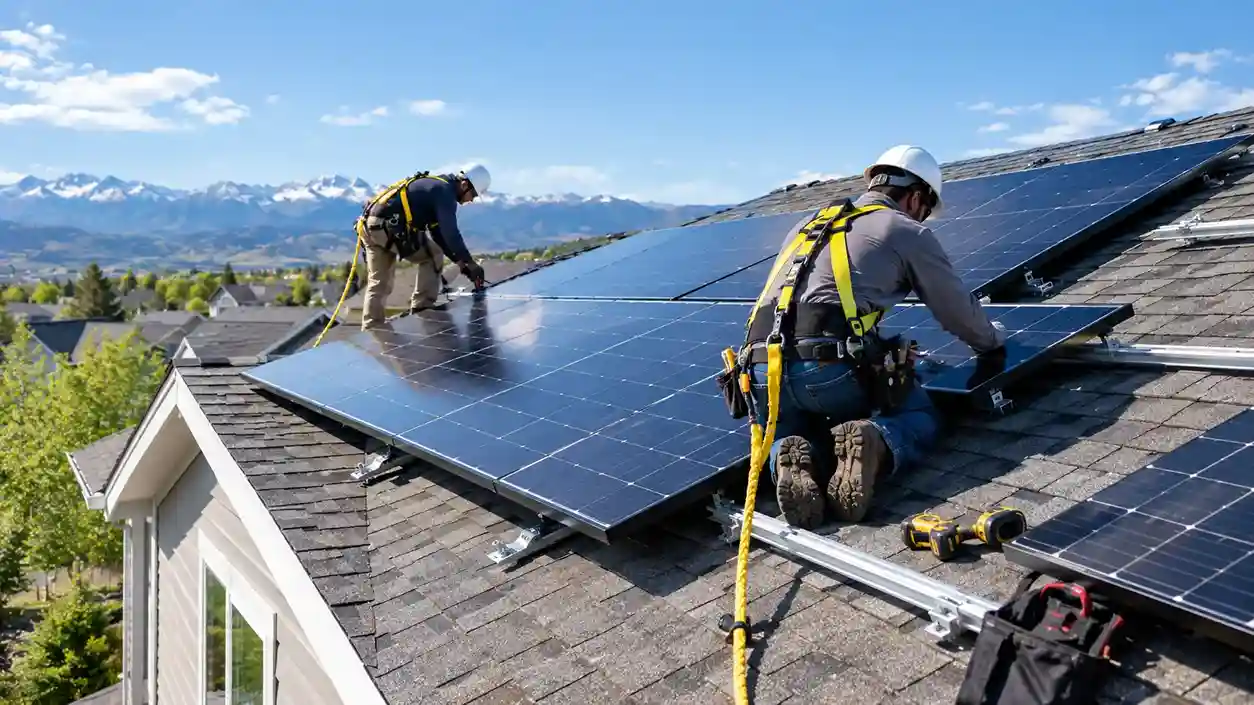
Solar panel installation in Colorado typically costs somewhere between roughly $2.65 and $3.40 per watt before incentives, depending on the source and system, and the process runs from design and permitting through utility approval. The roof work itself often takes only a day or two. Since the federal homeowner tax credit ended for systems completed after December 31, 2025, Colorado homeowners now rely on state tax exemptions, net metering, and utility programs to improve the economics. This guide covers what installation involves, what it costs, which incentives remain, and how to choose an installer you can trust.
Quick answers
- Cost: Multiply your system size by the price per watt. A 7 kW system at $2.65 to $3.40 per watt would run roughly $18,550 to $23,800 before incentives. This is an illustration, not a quote.
- Timeline: Expect weeks to a few months from contract to turning the system on, depending on your city or county permitting and your utility. One Pro Bid customer’s Google review describes going from first contact to production in about seven weeks, with a one-day install.
- Federal credit: Not available for homeowners who buy in 2026. Businesses and third-party-owned systems follow different rules (see the commercial section).
- Still available: Colorado’s state sales tax exemption on solar equipment, a property tax exemption, net metering, and utility or local programs that vary by address.
How Does Solar Panel Installation Work in Colorado?
Most projects follow the same five stages, whether you are a homeowner or a business.
Energy review and site assessment
A good proposal starts with your actual electricity use, not a guess. Your consultant looks at 12 months of usage, your roof (age, pitch, orientation, shading), and your electrical panel. Pro Bid’s consultants help match your energy needs to the right equipment.
Design and engineering
The design sets panel count and layout, inverter type, and whether a battery makes sense. In Colorado, roof condition matters. If your roof will need replacing within the life of the system, address it first or plan a detach and reset later.
Permits and utility interconnection
Your city or county must approve the plans, and your utility (Xcel Energy for much of the Front Range) must approve the connection. This paperwork is where most of the calendar time goes. Ask any installer who files it and who follows up.
Installation
Crews mount racking, panels, inverters, and wiring, often in one to two days for a typical home. Larger or more complex homes and commercial systems take longer.
Inspection and permission to operate
After the local inspection, the utility grants permission to operate (PTO). Do not switch the system on before PTO.
Timelines vary by jurisdiction and utility workload, so treat any single estimate as a range, not a promise.
How Much Does Solar Panel Installation Cost in Colorado?
Your price depends on five main factors:
- System size (driven by your usage and roof space)
- Equipment (panel and inverter type, optional battery)
- Roof complexity (multiple planes, steep pitch, tile or metal)
- Electrical work (panel upgrades, EV chargers, trenching for ground mounts)
- Financing (cash, loan, lease, or PPA)
Two estimates can differ a lot even for the same house, so compare proposals line by line: price per watt, panel and inverter models, warranties, and exactly what is included.
Colorado Solar Incentives After the Federal Credit Ended
| Incentive | What it does | What to know |
|---|---|---|
| Federal residential credit (Section 25D) | Was 30% of system cost | Ended for systems completed after 12/31/2025. Systems finished in 2025 can still claim it. |
| State sales tax exemption | Exempts qualifying solar components from Colorado’s 2.9% state sales and use tax | Applies at purchase. Local taxes may differ. See Colorado Dept. of Revenue guidance. |
| Property tax exemption | Keeps the added value of a residential system out of your assessment | You do not pay higher property tax for the panels’ added value. |
| Net metering | Credits the power you send to the grid against your bill | Excess credits roll to the next month. Rules and size limits vary by utility by DSIRE. |
| Utility and local programs | Rebates or production payments | Vary by address. Xcel’s Solar*Rewards has enhanced options for income-qualified customers. Some cities offer rebates too. |
| State battery credit | Colorado has offered a 10% income tax credit for home batteries | Program dates have been in flux. Confirm current status on Form DR 1307. |
One practical rule: apply for utility rebates before you install. Many programs require pre-approval, and installing first can disqualify you. A consultant who knows your utility’s rules can save real money here.
Buying vs. leasing matters for incentives
When you own the system (cash or loan), the sales and property tax exemptions and any utility rebates generally come to you. With a lease or PPA, the company that owns the system captures the tax benefits and passes some value to you through pricing, if at all. Ask for the math in writing.
Residential Solar Panel Installation: What Colorado Homeowners Should Know
Pro Bid’s residential solar services cover the whole life of a home system. A few Colorado-specific points are worth planning for.
Hail and snow
Colorado’s hail is a real consideration. Ask whether the modules you are quoted carry Class 4 impact-resistance ratings, and how the racking is rated for local snow load. Panels also keep producing in cold, clear weather.
New home or existing home
If you are building, new home solar installation can be planned alongside the roof and electrical design. If your house is already built, an existing home install starts with a roof and panel assessment. Builders can look at solar for homebuilders.
Backup power
A grid-tied system without a battery shuts off during an outage, which is a safety requirement for utility crews. If outages worry you, ask about battery backup and backup power options.
Cut your load first
Air sealing and insulation can lower the system size you need. Pro Bid also offers weatherization and electrification for heat pumps and efficient appliances.
Already have solar?
If your system is underperforming, your usage has grown (EV, hot tub, addition), or your roof needs work, see existing solar service.
Commercial Solar Installation in Colorado
Businesses, churches, schools, and government and municipal buildings have different priorities than homeowners: roof or ground space, daytime load profile, demand charges, and tax treatment.
Pro Bid’s commercial solar services run from design and installation through upkeep, temporary removal, and replacement, with licensed and insured electricians, and also include industrial generators and backup battery systems.
On federal incentives, commercial and third-party-owned projects can still use the Section 48E clean electricity credit, but the 2025 law tightened the timing. Projects generally had to begin construction by July 4, 2026, or be placed in service by December 31, 2027. See the IRS overview. Because the construction-start date has passed, confirm your project’s status with a tax professional before relying on the credit.
How to Choose a Solar Installer in Colorado
If you have searched “solar installers near me,” you have seen plenty of options. These checks separate them:
- Licensed electricians on the job. Ask who actually does the electrical work and whether they are licensed and insured.
- A proposal built from your usage. If an installer never asks for your electric bills, the system may be mis-sized.
- Transparent pricing. Look for price per watt, equipment models, and warranties in writing.
- Permits and utility paperwork handled. Ask who files and who follows up.
- Ownership and incentive clarity. Know who gets the tax benefits and rebates.
- Service after install. Systems need monitoring and occasional repair. Ask whether the installer services what it installs, and whether it works on systems it did not install.
- Local presence and reviews. Read recent reviews for how problems were handled, not just how the sale went.
Pro Bid Energy is a Colorado-based solar company in Commerce City, with a team that handles residential, commercial, and home builder projects. Learn more about Pro Bid .
Ready for numbers based on your home or building? Request a free quote or call (303) 623-1531.
Frequently Asked Questions
How long does solar panel installation take in Colorado?
The physical install often takes one to two days for a typical home. The full process, including design, permitting, and utility approval, commonly takes several weeks to a few months depending on your jurisdiction and utility.
Is the federal solar tax credit still available in Colorado?
Not for homeowners who buy a system completed after December 31, 2025. Systems completed in 2025 can still claim it. Businesses and third-party-owned systems follow separate rules, so check with a tax professional.
Will solar panels increase my property taxes in Colorado?
Colorado exempts the added value of qualifying residential solar from property tax assessment, so your taxes should not rise because of the panels.
Do solar panels work during a power outage?
A grid-connected system shuts off during a blackout for safety. With a compatible inverter and battery, you can keep power on for essential loads or the whole home.
Do solar panels work in Colorado winters and hail?
They produce power in cold, sunny conditions, and snow typically slides off or melts. For hail, ask for impact-rated (Class 4) modules and confirm your insurance coverage.
Should I buy or lease solar in Colorado?
Buying generally gives you the state tax exemptions and utility rebates and the most lifetime savings. Leasing lowers upfront cost but shifts the incentives to the system owner. Get both options quoted side by side.
What is net metering in Colorado?
Net metering credits you for the electricity your panels send to the grid, which offsets what you would otherwise buy later. Excess credits roll over month to month. Limits and rates vary by utility, so ask yours.
Can you service or move an existing solar system?
Yes. Pro Bid offers existing solar service and detach and reset when your roof needs work. For more Information you can contact us (303) 623-1531